
India is set to witness a significant transformation in its labor and taxation framework starting April 1, 2026. These changes will directly impact salaried employees, businesses, and taxpayers across the country. From how your salary is structured to how quickly you receive your dues after leaving a job, the new rules aim to bring transparency, simplicity, and financial security.
A New Look for Your Salary Structure:
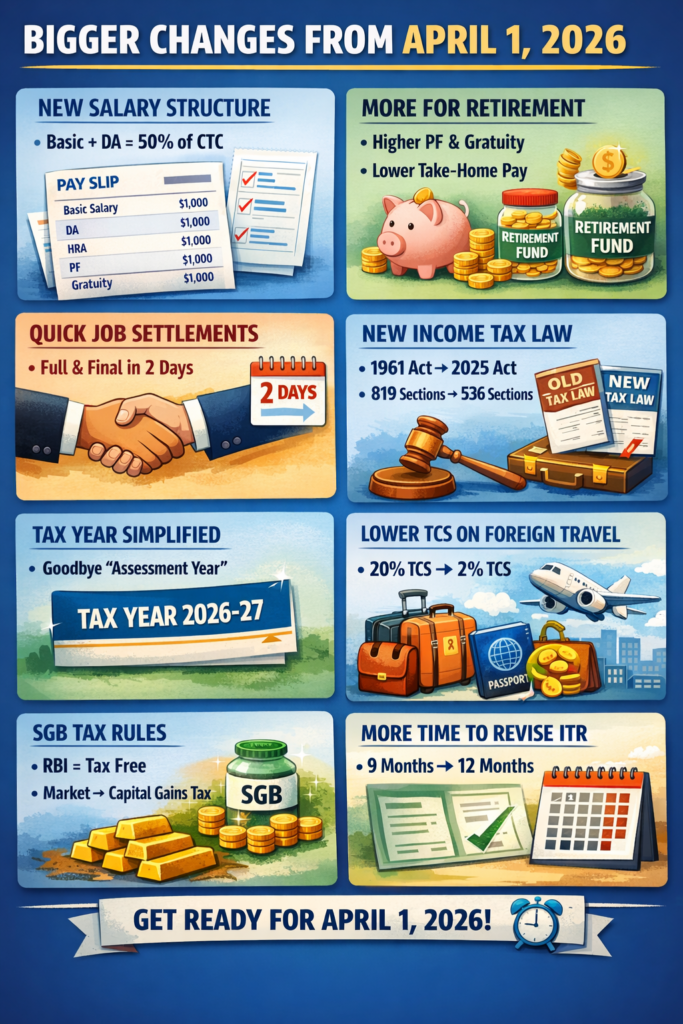
Under the Code on Wages, 2019, companies will now be required to ensure that an employee’s basic salary, dearness allowance (DA), and retaining allowance together make up at least 50% of the total Cost to Company (CTC).
For years, many organizations kept the basic salary relatively low—often between 25% to 40% of the CTC—to reduce contributions toward provident fund (PF) and gratuity. This practice allowed employees to receive a higher take-home salary in the short term.
With the new rule in place:
- Employers will have to increase the basic salary component
- Any allowances exceeding 50% of CTC will be treated as part of wages
This change will apply to businesses of all sizes—from small startups to large corporations.
Higher Retirement Savings, Lower Take-Home Pay:
An increase in the basic salary will directly affect retirement-related benefits:
- Provident Fund (PF): Contributions will increase as they are calculated on basic pay
- Gratuity: The final payout will be higher since it depends on the last drawn basic salary
For employees, this means:
- A possible reduction in monthly take-home salary initially
- A larger retirement corpus and better long-term financial security
For companies:
- The cost of employing staff is expected to rise by approximately 5% to 15%, especially in sectors like IT, retail, and BPO.
Faster Full and Final Settlement:
One of the most employee-friendly reforms is related to job exits. Under the updated provisions of the wage code:
- Employees must receive their full and final settlement (F&F) within two working days of their last working day
- This applies whether the employee resigns or is terminated
Previously, employees often had to wait between 30 to 90 days to receive their dues.
Delays in payment will now be considered a legal violation, and employees can file complaints with labor authorities to claim their dues along with applicable interest.
A New Income Tax Law Replaces the Old :
India will also introduce a simplified tax regime through the Income Tax Act 2025, replacing the decades-old Income Tax Act 1961.
Key highlights:
- The number of sections has been reduced from 819 to 536
- The objective is to make tax laws easier to understand and comply with
Income earned until March 31, 2026, will still be governed by the old law, while income from April 1, 2026, onward will fall under the new system.
Goodbye “Assessment Year,” Hello “Tax Year”
The new law removes the confusing concepts of “previous year” and “assessment year.” Instead, a single term—Tax Year—will be used.
For example:
- The period from April 1, 2026, to March 31, 2027, will simply be referred to as Tax Year 2026–27
This change is expected to simplify tax filing for millions of taxpayers.
Relief for Foreign Travel and Education Expenses :
In a major relief for individuals spending money abroad:
- The Tax Collected at Source (TCS) on foreign travel and remittances above ₹7 lakh will drop from 20% to just 2%
This will:
- Improve cash flow for travelers and students
- Reduce the burden of blocked funds
Tax Rules for Sovereign Gold Bonds Revised :
Investors in Sovereign Gold Bond (SGBs) should note an important change:
- If bonds are purchased directly from the Reserve Bank of India and held till maturity → Gains remain tax-free
- If purchased from the secondary market → Capital gains tax will apply at maturity
More Time to Revise Income Tax Returns :
Taxpayers will now get additional time to correct errors in their returns
- The revision window has been extended from 9 months to 12 months
- However, revisions made after 9 months may attract a prescribed fee
The reforms coming into effect from April 1, 2026, mark a major shift in India’s economic and regulatory landscape. While some changes—like reduced take-home salary—may feel challenging in the short term, the long-term benefits include better financial security, faster settlements, and a simpler tax system.
For employees and taxpayers alike, staying informed and adapting early will be key to making the most of these changes.